Direktwahl nach Stärke

Filz-Zuschnitte nach Dicke auswählen

Vergleichen Sie Einsatzgebiet, Rohdichte (weich vs. fest) und Selbstklebe-Ausrüstung auf einen Blick – und wählen Sie direkt die passende Filzplatte.

Dünne Schutzlage

Für flache Zwischenlagen, Spaltausgleich und feinen Oberflächenschutz

1 mm Filz eignet sich überall dort, wo das Material konstruktiv kaum auftragen darf – ideal für hauchdünne Trennlagen, feine Dichtungen, Einlagen und den Schutz empfindlicher Oberflächen.

Flache Konstruktionslage

Für Schutzflächen, Gleitlagen und präzise Zuschnitte

2 mm Filz bietet spürbar mehr Materialvolumen als 1 mm bei weiterhin geringer Aufbauhöhe – perfekt für technische Zwischenlagen, Montageflächen, Gehäusebau und eigene Streifenzuschnitte.

Stabil & Dämpfend

Für belastbare Bauteilauflagen, Dämpfung und Raumakustik

5 mm Filz bietet ein kräftiges Faservolumen für mittlere bis hohe Beanspruchung – ideal für Werkbank- und Transportauflagen, Körperschalldämmung, Akustikflächen und robuste Gleitlagen.

Kräftige Ausgleichsstärke

Für druckfeste Unterlagen, Dichtungen und mechanische Beanspruchung

6 mm schließt die Lücke zwischen Standard- und Schwerlastfilzen – optimal, wenn bei Dichtungen, Führungen, Warenträgern oder Unterlagen zusätzliches Materialvolumen gefragt ist.

Stark & Belastbar

Für Schwingungsdämpfung, Schallschutz und hohe Auflasten

8 mm Filzplatten kommen zum Einsatz, wenn dünnere Lagen unter Last nachgeben würden – entwickelt für Maschinenbau, Transportauflagen, Körperschallentkopplung und schwere Dämpfung.

Massive Dämpfungsplatte

Für schwere Auflasten, Entkopplung und industrielle Funktionsteile

10 mm starker Walkfilz bietet enormes Materialvolumen zur Aufnahme hoher Druckkräfte, zur Reduzierung tieffrequenter Schwingungen sowie zur Fertigung von Schmier- und Dichtfilzen.

Schwerlast & Maschinenbau

Für hochbelastete Druckpolster, Anschlagpuffer und Aggregate

In 12 mm Stärke führen wir ausschließlich unseren hochverdichteten, festen Walkfilz (0,36 g/cm³) – konzipiert für extreme Flächenpressung, langlebige Puffer und industrielle Beanspruchung.

Maximale Materialstärke

Für höchste Druckaufnahme, Stoßabsorption und Maschinenschutz

15 mm fester Walkfilz (5.400 g/m²) ist unsere stärkste Lagerplatte für extreme mechanische Anforderungen – ideal für schwere Maschinenauflagen, Prallschutz und maximale Körperschallentkopplung.

Material Selection & Bulk Density

Technical felt: Soft or firm?

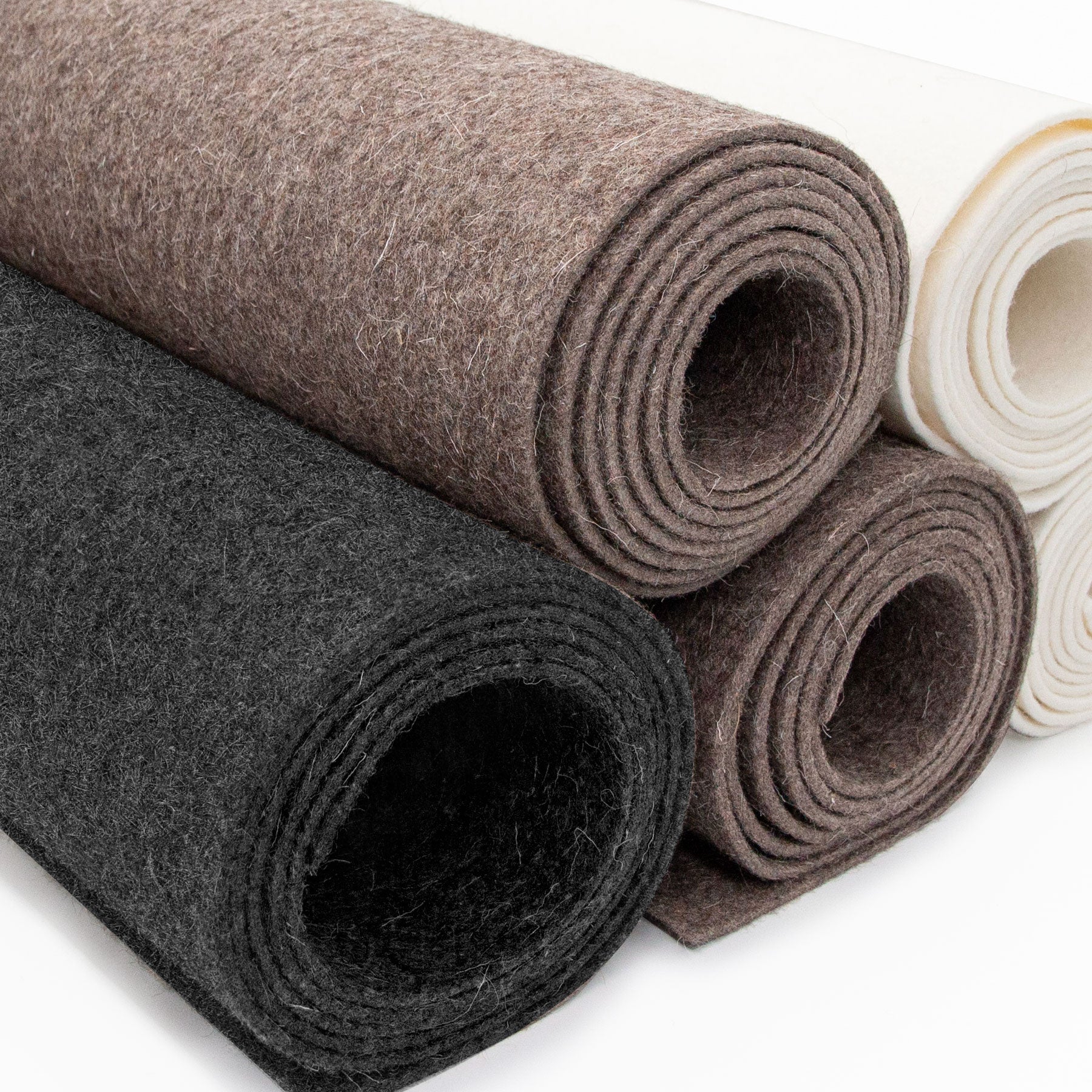
In addition to the material thickness, the specific density (bulk density in g/cm³) determines how fulled wool felt behaves. Both varieties are made of 100% pure wool and remain easy to cut and bend.

Flexible
Flexible & supple

Soft wool felt

Ideal when you want the felt to provide gentle cushioning or padding, or to conform effortlessly to surfaces, edges, furniture, and curves.

Upholstery & Padding Curves & Edges Sewing & Craft Projects
View Soft Wool Felt
Rule of thumb for density: Choose "Soft" (0.20 g/cm³) if the felt is to be used for cushioning, sound absorption, or to conform easily to curved surfaces. Choose "Firm" (0.36 g/cm³) if it needs to maintain its shape under load or be cut to precise dimensions.
Not sure about the thickness, color, or hardness?
Material Testing Before Placing a Large Order

Not sure about the thickness, color, or hardness?

Test color effects, material thickness, bulk density (soft vs. firm), and adhesive strength in advance—either directly on the component or in the room—using our specially curated sample sets.

Vehicle & Interior Construction Camper Felt Pattern Sets

Test the colors, stretch, and adhesive options on the original item before removal.

Wall & Room Acoustics Acoustic Felt Sample Set

100% sheep's wool, 4–5 mm, for color and surface sampling.

Industry & Technology Single-Pattern Walk Felt

0.20 vs. 0.36 g/cm³ in 1–15 mm, selectable directly for each product.

View the Sample Sets Individual patterns can also be selected directly on each product page.
Frequently Asked Questions

Questions About Felt by the Meter, Thickness, and Material Selection

The most important answers regarding the selection of the appropriate material thickness, bulk density (soft vs. firm), self-adhesive coating, and processing for project or industrial applications.

What thickness of felt do I need for my project?

For thin separator layers, laminations, and thin structures, 1–2 mm is usually sufficient. 3 mm is the standard thickness for camper and vehicle interiors, interior finishes, mounting pads, and technical surface protection.

4–5 mm is ideal for wall paneling, room acoustics, and greater sound absorption. 8–10 mm and 15 mm are used for heavy loads, vibration isolation, and in mechanical engineering.

What is the difference between soft (0.20 g/cm³) and firm (0.36 g/cm³) wool felt?

The difference lies in the bulk density: Soft fulled felt (0.20 g/cm³) is more flexible, more pliable, and can be easily draped over edges, curves, and contours.

Dense full-wale felt (0.36 g/cm³) is compressed to nearly twice the density. As a result, it is significantly more resistant to compression and abrasion and maintains its dimensions better in technical cuts—yet remains flexible when sold in rolls.

Is solid wool felt completely rigid, like a sheet?

No. Although dense wool felt (0.36 g/cm³) is significantly sturdier and hardly yields under pressure, it is not a rigid board but rather a textile material that has been highly compressed through fulling.

It is supplied in rolls, can be laid out flat, and is ideal for pressure-resistant underlays, sliding surfaces, scrapers, and dimensionally accurate strip cuts.

When should I choose walk felt and when should I choose needle felt?

Technical felt (100% wool, bonded by moisture, heat, and pressure) is the top choice for industrial applications, sealing, cushioning, sliding surfaces, and precise cuts without fraying.

Needle-punched felt (mechanically needle-punched fibers made from sheep's wool or polypropylene) is significantly more elastic and is primarily used for large-area wall, ceiling, and vehicle trim.

Is felt sold by the meter in a self-adhesive form?

Yes, both our camper felts (stretch felt and natural wool felt, 3 mm thick) and our acoustic felt (4–5 mm thick) are available with a ready-to-install, strong-adhesive backing.

To ensure full adhesive strength, the surface must be dry and free of dust and grease. For highly textured or open-pored surfaces, we recommend performing a brief test application on a sample first.

When is self-adhesive felt a good choice—and when is it better to use felt without adhesive?

Self-adhesive roll material saves a tremendous amount of installation time in automotive, trade show, and interior construction projects, since there is no need to apply spray or surface adhesives—it can be applied directly from the backing paper.

Felt without an adhesive backing is useful when the material is to be laid loosely, mechanically fastened, sewn, or applied to special substrates using its own two-component or contact adhesive.

What thickness of felt is suitable for camper and automotive interiors?

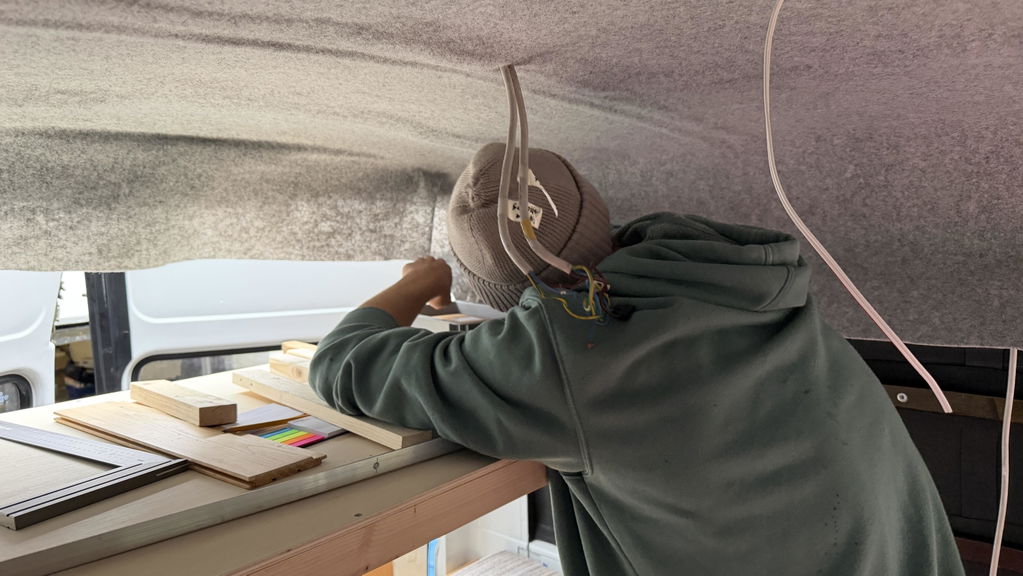
In vehicle interior trim, 3 mm has proven to be the optimal standard thickness: The material reliably covers sheet metal seams and uneven surfaces, yet can still be easily shaped to fit around creases, along side members, and around wheel wells.

For complex 3D curves, we recommend our extremely stretchy 3 mm stretch felt (PP). If you value 100% natural fibers, moisture regulation, and a comfortable indoor climate, choose the 3 mm Camper wool felt.

What thickness of felt is best suited for room acoustics and wall surfaces?

For acoustically effective wall and ceiling cladding in residential, office, and commercial construction, we specifically use 4–5 mm thick wool felt.

This thickness provides the necessary fiber volume to effectively absorb high- and mid-frequency reverberation in the room, while also ensuring a smooth, high-quality surface appearance.

What are the roll widths of the various felts?

Our soft industrial fulled felt (0.20 g/cm³) is 1.70 m wide, while the firm industrial fulled felt (0.36 g/cm³), as well as the acoustic and camper wool felt, are 1.50 m wide.

The synthetic Camper stretch felt (polypropylene) comes in rolls with an exceptionally wide width of 2.00 m, allowing even the side walls and ceilings of large vans to be covered seamlessly in a single piece.

How can you cut felt by the meter on site?

A major advantage of genuine wool felt and needle-punched felt is that the cut edges do not fray and do not need to be trimmed. Thicknesses ranging from 1 to 5 mm can be cut cleanly with a sharp utility knife (guided along a steel ruler) or a sturdy fabric/carpet scissors.

For high-density felts with a thickness of 8–15 mm or more, we recommend using a sharp replaceable blade in several passes, or using electric circular blades or industrial cutting methods.

What is the difference between fabric sold by the meter and fabric cut to size?

Fabric sold by the meter is delivered in a single piece from the roll in the length you specify (ranging from 1.50 m to 2.00 m at full roll width)—ideal for large-scale linings and your own further processing.

If you need precisely defined strips, rings, stamped parts, or sheet sizes for mass production, mechanical engineering, or assembly, we can manufacture them to order, tailored exactly to your specifications.

Do you also supply special thicknesses (> 15 mm) or specific densities (g/cm³)?

Yes. In addition to our standard product line, which is available immediately from stock (1 to 15 mm in densities of 0.20 and 0.36 g/cm³), we also supply industrial and commercial customers with technical felts in thicknesses greater than 15 mm.

Similarly, different specific densities (g/cm³ according to DIN 61200) as well as custom widths and configurations are available upon request.

Is wool felt suitable for unprotected outdoor use?

Although pure wool felt is naturally stain- and moisture-resistant, it is designed for dry indoor environments and weather-protected technical applications.

In cases of prolonged direct exposure to the elements or persistent moisture, a moisture-resistant synthetic needle-punched felt (polypropylene) should be used instead of natural wool felt.

How can I test the color, density, and adhesive strength before placing a large order?

Using our curated sample sets (for camper and acoustic felt) as well as the individual sample option available directly on the walk felt product pages, you can test the material thickness, bulk density, and adhesion in advance using the actual component.

This ensures that, for larger quantities by the running meter or renovation projects, the color, texture, and strength meet your technical requirements exactly.

Ready for your project?

Find the right felt by the meter now

Select the appropriate material thickness from our in-stock inventory right above—or contact us if you need larger quantities by the running meter, specific densities (g/cm³), or custom-cut pieces.