The Felt Store Europe · Wool felt cutouts

Wool Felt Sheets - Made in Germany

Choose the right felt thickness for protection, cushioning, padding, furniture protection, soundproofing, and technical applications. Available directly from stock—soft, firm, or self-adhesive.

  • Walked felt with a high wool content in accordance with DIN 61200 – sound- and shock-absorbing
  • Available thicknesses ranging from 1 mm to 15 mm for every application
  • Available in two bulk densities (soft: 0.20 g/cm³ and firm: 0.36 g/cm³); other densities available upon request
  • Available without adhesive or with a self-adhesive backing
Material Selection & Bulk Density

Technical felt: Soft or firm?

In addition to the material thickness, the specific density (bulk density in g/cm³) determines how fulled wool felt behaves. Both varieties are made of 100% pure wool and remain easy to cut and bend.

Flexible
Flexible & supple

Soft wool felt

Ideal when you want the felt to provide gentle cushioning or padding, or to conform effortlessly to surfaces, edges, furniture, and curves.

Upholstery & Padding Curves & Edges Sewing & Craft Projects
Rule of thumb for density: Choose "Soft" (0.20 g/cm³) if the felt is to be used for padding, sound absorption, or to conform easily to curved surfaces. Choose "Firm" (0.36 g/cm³) if it needs to maintain its shape under load or be cut to precise dimensions.
Direct Election Based on Strength

Select Felt Cuts by Thickness

Compare applications, bulk density (soft vs. firm), and self-adhesive properties at a glance—and choose the right felt sheet right away.

1 mm
Thin protective layer

For thin interlayers, gap filling, and fine surface protection

1 mm felt is suitable for any application where the material must be as thin as possible—ideal for ultra-thin separator layers, fine gaskets, inserts, and the protection of sensitive surfaces.

2 mm
Flat construction layer

For protective surfaces, sliding layers, and precise cuts

2-mm felt offers noticeably more material volume than 1-mm felt while still maintaining a low profile—perfect for technical interlayers, mounting surfaces, enclosure construction, and custom strip cuts.

5 mm
Stable & Cushioned

For high-load component supports, vibration damping, and room acoustics

5 mm felt offers a high fiber volume for medium to heavy-duty use—ideal for workbench and transport pads, structure-borne sound insulation, acoustic panels, and sturdy sliding layers.

6 mm
Strong balancing power

For pressure-resistant substrates, gaskets, and mechanical stress

6 mm bridges the gap between standard and heavy-duty felts—ideal when additional material volume is required for gaskets, guides, product carriers, or pads.

8 mm
Strong & Durable

For vibration damping, sound insulation, and heavy loads

8-mm felt sheets are used when thinner layers would give way under load—designed for mechanical engineering, transport pads, structure-borne sound isolation, and heavy-duty damping.

10 mm
Solid Damping Plate

For heavy loads, decoupling, and industrial functional parts

10-mm-thick full-face felt offers a tremendous amount of material to absorb high compressive forces, reduce low-frequency vibrations, and manufacture lubricating and sealing felts.

12 mm
Heavy-Duty & Mechanical Engineering

For high-load pressure pads, stop buffers, and power units

In a 12-mm thickness, we carry only our high-density, firm full-face felt (0.36 g/cm³)—designed for extreme surface pressure, durable buffers, and industrial applications.

15 mm
Maximum material thickness

For maximum pressure resistance, shock absorption, and machine protection

15 mm solid felt (5,400 g/m²) is our strongest mounting plate for extreme mechanical demands—ideal for heavy machinery supports, impact protection, and maximum structure-borne sound isolation.

Frequently Asked Questions

Questions About Felt Cuts, Thickness, and Material Selection

The most important answers regarding the selection of the appropriate material thickness, bulk density (soft vs. firm), self-adhesive properties, and processing for use in projects, crafts, or industrial applications.

What thickness of felt do I need for my application?

For thin separator layers, friction protection, and low profile heights, 1–2 mm is usually sufficient. 3 mm is the standard thickness for mounting pads, workpiece protection, interior finishing, and technical surface protection.

5 mm and 6 mm are ideal for load-bearing component supports and thicker leveling layers. 8 mm, 10 mm, 12 mm, and 15 mm are used for high loads, to reduce contact noise, and in mechanical engineering.

What is the difference between soft (0.20 g/cm³) and firm (0.36 g/cm³) wool felt?

The bulk density (based on DIN 61200) determines the resistance to compression and deformation: Soft walk felt (approx. 0.20 g/cm³) is more compressible, more flexible, and easily compensates for unevenness between contact surfaces.

Dense full-wale felt (approx. 0.36 g/cm³) is significantly more densely compressed. As a result, it is more resistant to compression, more abrasion-resistant, and maintains its dimensions better under uniform loading, in technical interlinings, and in precision cuts.

Is solid wool felt completely rigid, like a sheet?

No. Although dense wool felt (approx. 0.36 g/cm³) is significantly sturdier and yields very little under surface pressure, it is not a rigid board but rather a fiber-based material that has been highly compressed through fulling.

The felt sheets lie flat and are ideal for use as pressure-resistant underlays, sliding surfaces, scrapers, and dimensionally stable cut strips; however, they remain flexible during processing.

What material are the cut pieces of fulled felt made of, and how heat-resistant are they?

Our technical felt blanks are made from a proven wool-viscose blend (sheep’s wool with a functional viscose component) that is compacted through moisture, heat, pressure, and movement without the use of additional binders.

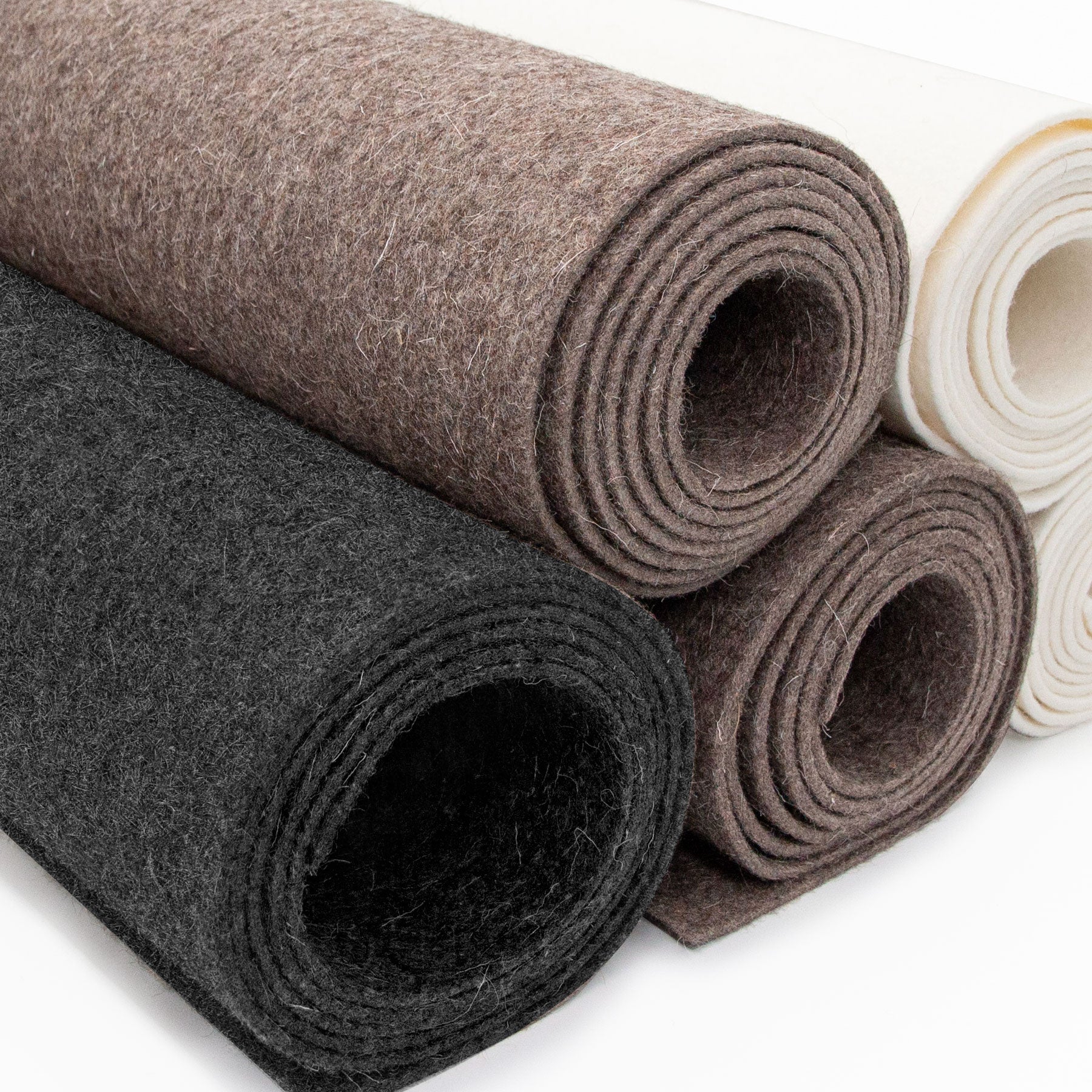
The material is available in off-white, heather gray, and black, and can withstand temperatures of up to approximately 100 °C in dry indoor environments.

When should I choose walk felt and when should I choose needle felt?

Due to its high and uniform fiber density, technical needle-punched felt is the top choice for protective, separating, and intermediate layers, as well as for sealing, cushioning, and precise cuts without fraying.

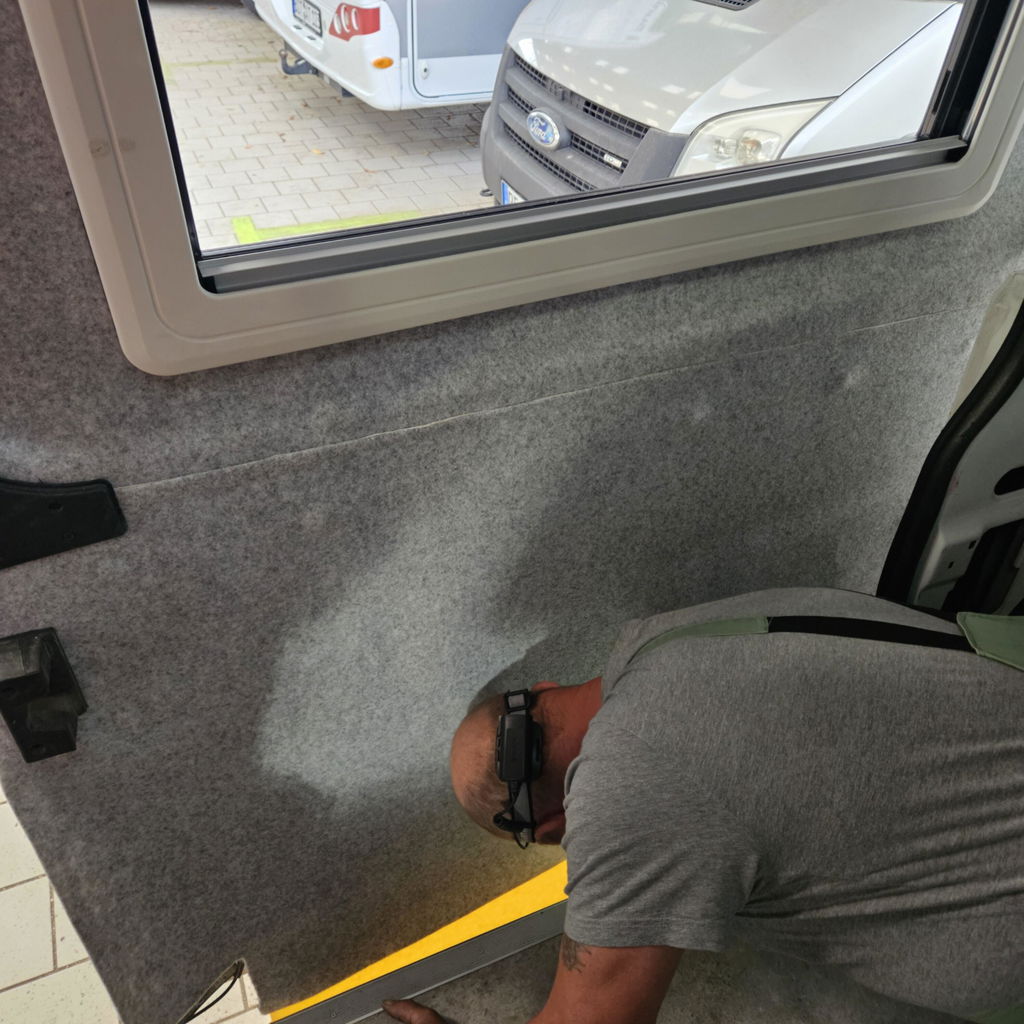
Needle-punched felt (mechanically needle-punched fibers made from sheep's wool or polypropylene) is significantly more elastic and is primarily used in roll form for large-area wall, ceiling, and vehicle paneling.

Are the felt cutouts also available in a self-adhesive version, and what kind of adhesive is used?

Yes, our walk felt sheets are available both without adhesive and with a strong, single-sided self-adhesive backing featuring an age-resistant acrylic dispersion adhesive and a removable release liner.

The adhesive layer adheres reliably to clean, dry, dust- and grease-free surfaces such as metal, wood, smooth plastic, or painted components. It is important to apply firm pressure, as the adhesive reaches its full bond strength after several hours.

When is self-adhesive felt a good choice—and when is it better to use felt without adhesive?

Self-adhesive cut-to-size sheets save a lot of time in assembly, manufacturing, retail, and interior design, since no separate adhesive needs to be applied and the felt panel can be attached directly.

The adhesive-free version is recommended when the felt is placed loosely as a separator or workbench pad, mechanically fastened, or used in contact with oils and lubricants.

Which design is suitable for reducing friction and handling high pressure loads?

For mechanically stressed spacers, workpiece supports, and contact surfaces subjected to pressure, we recommend our dense felt (0.36 g/cm³) in thicknesses ranging from 3 mm to 15 mm.

The compact felt structure neatly separates components from one another, reduces friction, and retains its shape under vertical surface pressure. Strong lateral shear or thrust forces should be avoided through proper design.

Are these cut pieces suitable for dampening contact noise and vibrations?

Yes. When used as an elastic cushioning layer in flat applications, wool felt noticeably reduces contact noise, rattling, and vibrations between adjacent components made of metal, wood, or plastic.

While 3- to 6-mm-thick material is typically used to decouple housings, trim, and lightweight components, 8- to 15-mm-thick material provides support for heavy loads and shock absorption.

In what sizes and thicknesses can the felt cutouts be selected directly?

We carry cut-to-size pieces of fulled felt in thicknesses of 1, 2, 3, 5, 6, 8, 10, 12, and 15 mm. Standard sizes include 30 × 30 cm, 50 × 30 cm, 50 × 50 cm, as well as—for thicknesses up to 12 mm—90 × 60 cm and 120 × 90 cm (sometimes supplemented by 20 × 30 and 45 × 30 cm).

For 15-mm-thick felt sheets (5,400 g/m² for standard quality), the 30 × 30 cm, 50 × 30 cm, and 50 × 50 cm sizes can be ordered directly due to the material's high weight.

How can felt cutouts be further processed—do the edges fray?

Thanks to its fulled, non-directional fiber structure, the cut edges of fulled felt do not fray. Thicknesses ranging from 1 to 5 mm can be cut cleanly with a sturdy pair of scissors, a rotary cutter, or a sharp utility knife.

For thicknesses ranging from 6 to 15 mm, we recommend using a sturdy utility knife with a sharp blade (guided along a rail in several passes) or, for high-volume production, our industrial die-cutting and cutting services.

What is the difference between pre-cut pieces, fabric sold by the meter, and custom-made items?

Our custom cuts provide convenient felt sheets for immediate use or in smaller quantities. If you need large, continuous sheets, the same full-woven felt is also available by the meter in rolls (1.50 m wide for firm full-woven felt and 1.70 m wide for soft full-woven felt).

In addition, at our in-house production facility in Braunschweig, we manufacture custom sizes, strips, rings, and die-cut parts upon request—available without adhesive, or with self-adhesive backing on one or both sides.

Is wool felt suitable for unprotected outdoor use?

No. Our wool felt cut pieces and the acrylate dispersion adhesive coating are designed for dry indoor environments and weather-protected technical applications.

In cases of prolonged direct exposure to the elements or persistent moisture outdoors, a moisture-resistant synthetic needle-punched felt (e.g., polypropylene) should be used instead.

Are there volume discounts, special thicknesses (> 15 mm), or different bulk densities?

Automatic tiered pricing and volume discounts are displayed directly on the respective product page. For larger purchase quantities or framework agreements, we would be happy to provide you with a customized quote.

In addition to our standard inventory (1 to 15 mm in 0.20 and 0.36 g/cm³), we can also supply industrial and commercial customers with thicknesses greater than 15 mm and specific densities in accordance with DIN 61200 on a project-by-project basis.

Ready for your project?

Find the right piece of felt now

Select the appropriate material thickness and sheet size from our in-stock inventory right above—or contact us if you need larger quantities, custom cuts, die-cut parts, specific bulk densities (g/cm³), or custom dimensions.