





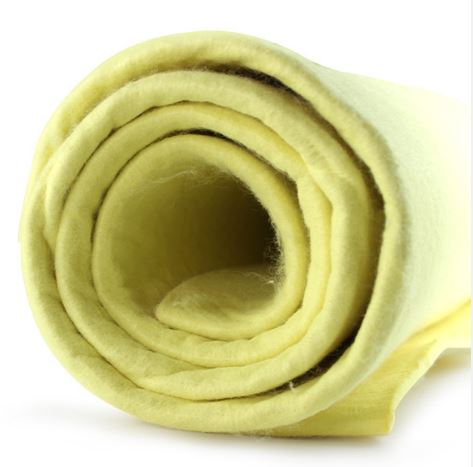

Aramid needle felts come in two classes: meta-aramid and pera-aramid. Aramid is a synthetically produced high-performance fiber whose molecules are characterized by relatively rigid polymer chains. These molecules are linked by strong hydrogen bonds, which transmit mechanical stresses very efficiently, allowing the use of chains with relatively low molecular weight. Aramid fibers share some general properties that distinguish them from other synthetic fibers:
- High strength
- Good resistance to organic solvents
- Non-conductive
- No melting point
- Low flammability
- Good fabric integrity at elevated temperatures
Meta-aramid (Nomex)

Meta-aramid fibers do not ignite, melt, or drip. They retain their mechanical properties at elevated temperatures. Although meta-aramid fibers have higher tensile strength and lower thermal conductivity than many FR fibers, they are soft to handle and can be processed similarly to conventional fibers.
Para-Aramid (Kevlar)

Due to their rigid molecular structure, pera-aramid fibers exhibit high toughness, a high tensile modulus, and high heat resistance. Para-aramid fibers have similar operating temperatures to meta-aramid fibers, but exhibit three to seven times higher strength and a higher modulus than meta-aramid . This makes them ideal for reinforcement and protection applications.
Precursor carbon felt

Polyacrylonitrile fibers (PAN) do not burn, melt, soften, or drip. PAN fibers are extremely heat and flame resistant (up to 1800 °F) and have low thermal conductivity. PAN fibers also exhibit high electrical resistance and high mechanical strength.